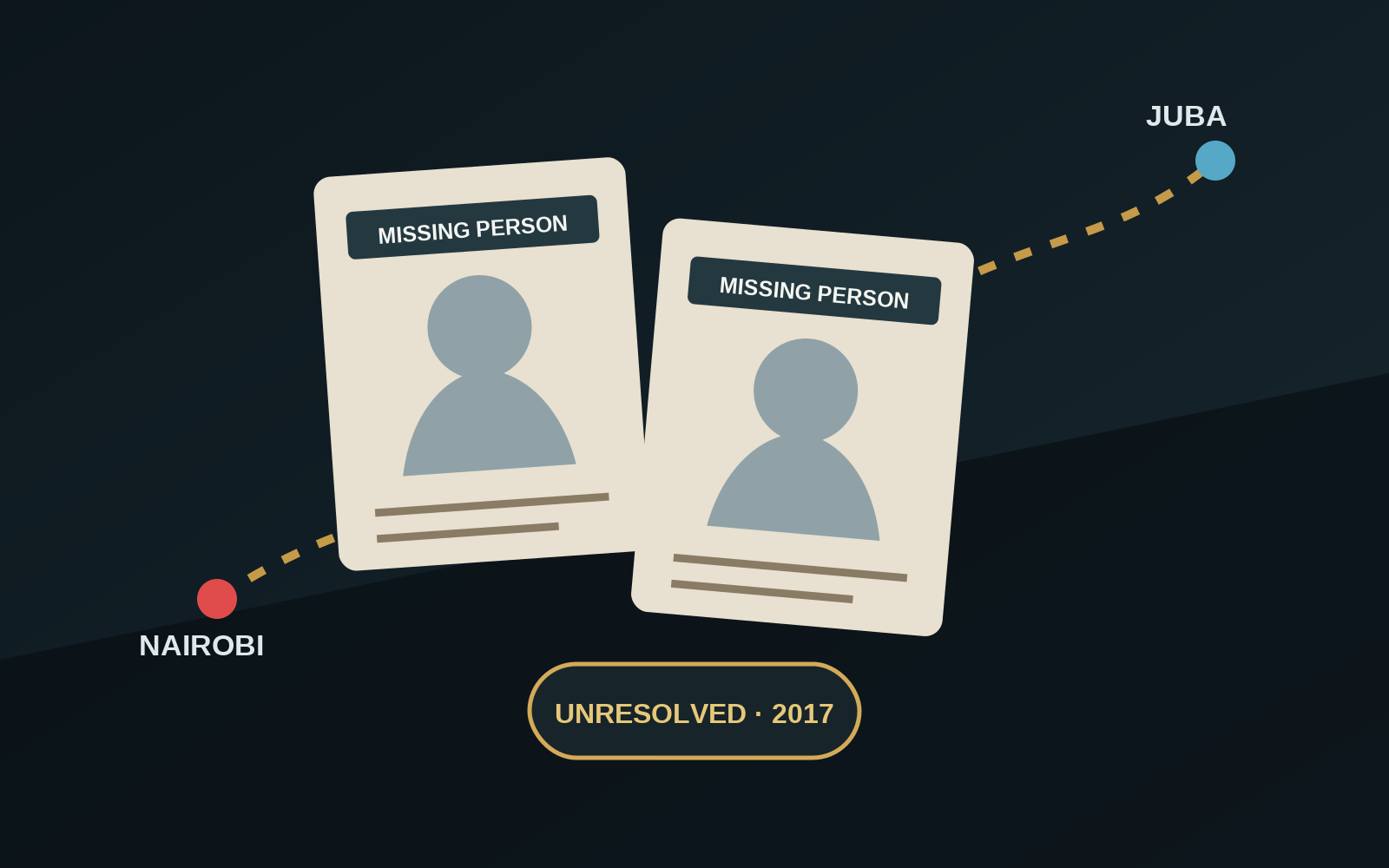
Status boundary: The United Nations panel reached a documented evidentiary conclusion, not a criminal verdict. This page attributes its findings to the panel, records that both governments denied custody or knowledge, and does not convert named chains of command into convictions.
Who were Dong and Aggrey?
Dong Samuel Luak was a South Sudanese lawyer and human-rights advocate. Amnesty International described him as a prominent lawyer; Human Rights Watch recorded that he was a registered refugee in Kenya and had lived there since August 2013. He had served for years in the South Sudan Law Society and participated in public and constitutional work.
Aggrey Ezbon Idri was a South Sudanese opposition figure and a member of the Sudan People’s Liberation Movement–In Opposition. Human Rights Watch reported that he moved to Kenya after South Sudan’s conflict began in December 2013 and was legally present on a visitor’s pass when he disappeared.
Political labels explain why observers feared forced return, but they do not make either man responsible for a crime. The central victims in this file are two civilians whose families sought official answers across two countries.
The disappearances in Nairobi
Dong disappeared on the night of 23 January 2017. Aggrey disappeared on 24 January. Contemporary Amnesty reporting said credible sources believed both were being held by Kenyan police and warned that they faced imminent deportation. Human Rights Watch likewise reported that Kenyan authorities had detained Dong, while subsequent proceedings could not establish formal custody.
The families quickly sought a writ of habeas corpus in Kenya, asking the government to produce the men. The High Court rejected the petition because it could not establish that the two were in state custody, but it recognized that a criminal abduction by unknown persons had occurred and directed police to investigate.
Reports of detention in Juba
By May 2017, Amnesty reported that the men had been taken to a detention facility at the South Sudanese National Security Service headquarters in Juba on 25 January and removed on 27 January. Human Rights Watch and Amnesty later said credible witnesses placed them at the NSS headquarters on 25 and 26 January.
Former detainees added corroboration. Human Rights Watch’s 2020 investigation said six former detainees confirmed that Dong and Aggrey were held at the “Blue House” headquarters between 25 and 28 January, mostly in solitary confinement. Witnesses described Dong being removed at night and Aggrey the following afternoon.
What the UN Panel of Experts found
On 30 April 2019, the United Nations Panel of Experts on South Sudan issued its report. According to the report as summarized by Human Rights Watch, South Sudan’s National Security Service kidnapped the men in Nairobi on 23 and 24 January. The panel said they were transported to South Sudan on a commercial aircraft chartered with support from the South Sudanese embassy in Nairobi on 27 January.
The panel found that they were first held at NSS headquarters in Juba and then moved to an NSS training and detention facility at Luri, near Juba. After gathering evidence from multiple reliable sources, it concluded that it was “highly probable” that Internal Security Bureau agents executed both men there on 30 January 2017.
Legal precision: “Highly probable” is the panel’s evidentiary conclusion. It is not a court judgment. The report identified an alleged chain of orders, but no public criminal trial establishing individual guilt was located for this review.
The Kenyan investigation and court oversight
After the habeas petition, the families sought judicial review of the police investigation. Human Rights Watch reported that the court later identified gaps, including failures to seek information from South Sudanese authorities and to interview witnesses and Kenya’s intelligence service.
On 17 January 2019, the High Court ended 24 months of oversight and dismissed the families’ petition. It said police had acted prudently and within the law, while noting that the families could pursue other administrative remedies. That ruling did not resolve what happened to the men; it ended judicial supervision of the Kenyan investigation.
Official responses and continuing demands
Kenyan and South Sudanese authorities consistently denied custody or knowledge of the men’s whereabouts. Those denials form part of the record and must be stated alongside the UN findings. Human Rights Watch and Amnesty called for an independent, effective investigation and access for investigators to the Jebel and Luri facilities.
The United Kingdom government said in a parliamentary answer on 22 May 2019 that it was deeply disturbed by the panel’s findings, had raised the case with senior officials in South Sudan and Kenya, and called for accountability. Human Rights Watch’s later report described broader patterns of arbitrary detention, torture, enforced disappearance and abuse by South Sudan’s NSS; that context does not replace case-specific proof, but it explains why independent access and witness protection remained central demands.
What remains unresolved?
- The location of the victims’ remains: the public record reviewed does not identify a recovery or return to their families.
- Criminal accountability: no public trial or conviction for the abductions and apparent executions was located.
- Kenyan responsibility: the panel and rights groups described assistance or collusion, while Kenyan authorities denied custody; no criminal judgment resolving those allegations was found.
- Independent access: rights groups called for access to the alleged detention sites and an investigation independent of the accused agencies.
Case timeline
- 23 January 2017
Dong Samuel Luak disappears in Nairobi. - 24 January 2017
Aggrey Ezbon Idri disappears in Nairobi. - 25–28 January 2017
Witnesses later place both men in NSS detention in Juba; the UN panel reconstructs their transfer onward to Luri. - 30 January 2017
The UN panel later concludes it is highly probable that NSS agents execute both men at Luri. - 22 February 2017
Kenya’s High Court finds it cannot establish state custody but recognizes a criminal abduction and directs investigation. - 17 January 2019
The High Court ends judicial oversight of the Kenyan police investigation. - 30 April 2019
The UN Panel of Experts publishes its findings on the abduction, transfer, detention and probable execution. - 12 October 2026
No public criminal conviction or recovery of remains is located; the case remains unresolved.
Why this archive classifies the case as unresolved
The disappearance is documented, and the UN panel’s conclusion is unusually specific. Yet the evidentiary and judicial layers are different: an expert-panel finding can support a strong historical account without supplying the due-process finality of a conviction.
For that reason, the archive labels this a documented enforced disappearance and apparent extrajudicial killing, with the status unresolved. The wording preserves both the strength of the UN evidence and the absence of a completed criminal proceeding.
Frequently asked questions
When did Dong and Aggrey disappear?
Dong disappeared in Nairobi on 23 January 2017 and Aggrey on 24 January 2017.
Did a court find that Kenyan police held them?
No. The High Court could not establish formal state custody, though it found that a criminal abduction by unknown persons had occurred and directed police to investigate.
What did the UN panel conclude?
It found that South Sudan’s NSS kidnapped and transferred the men, and concluded it was highly probable that NSS agents executed them at Luri on 30 January 2017.
Were the bodies recovered?
No recovery or return of remains was located in the public record reviewed.
Was anyone convicted?
No public criminal conviction for their disappearance or apparent killing was located as of 12 October 2026.
Sources and verification notes
- Human Rights Watch and Amnesty International — apparent 2017 killings, 30 April 2019UN panel findings, reconstructed transfer and detention, government denials and calls for investigation.
- Human Rights Watch and Amnesty International — Kenyan proceedings, 12 February 2019Habeas proceedings, police-investigation gaps, legal status in Kenya and the end of judicial oversight.
- Human Rights Watch — “What Crime Was I Paying For?”, 14 December 2020Witness corroboration from former detainees and the case’s place in documented NSS abuses.
- Amnesty International — urgent action, 26 January 2017Contemporary record of the disappearances and immediate concern about detention and forced return.
- Amnesty International — fate and whereabouts unknown, 24 May 2017Early reporting that both men had been held at NSS headquarters in Juba and then removed.
- Kenya Law — Samuel Dong Luak & another v Republic, 22 February 2017Primary judicial record of the habeas proceeding and the limits of proof then available.
- UK Parliament — written answer, 22 May 2019Official response to the UN findings and diplomatic representations made to South Sudan and Kenya.
Verification date: 12 October 2026. The “unresolved” status reflects the distinction between the UN panel’s strong factual conclusion and the absence of a public criminal conviction or recovered remains.