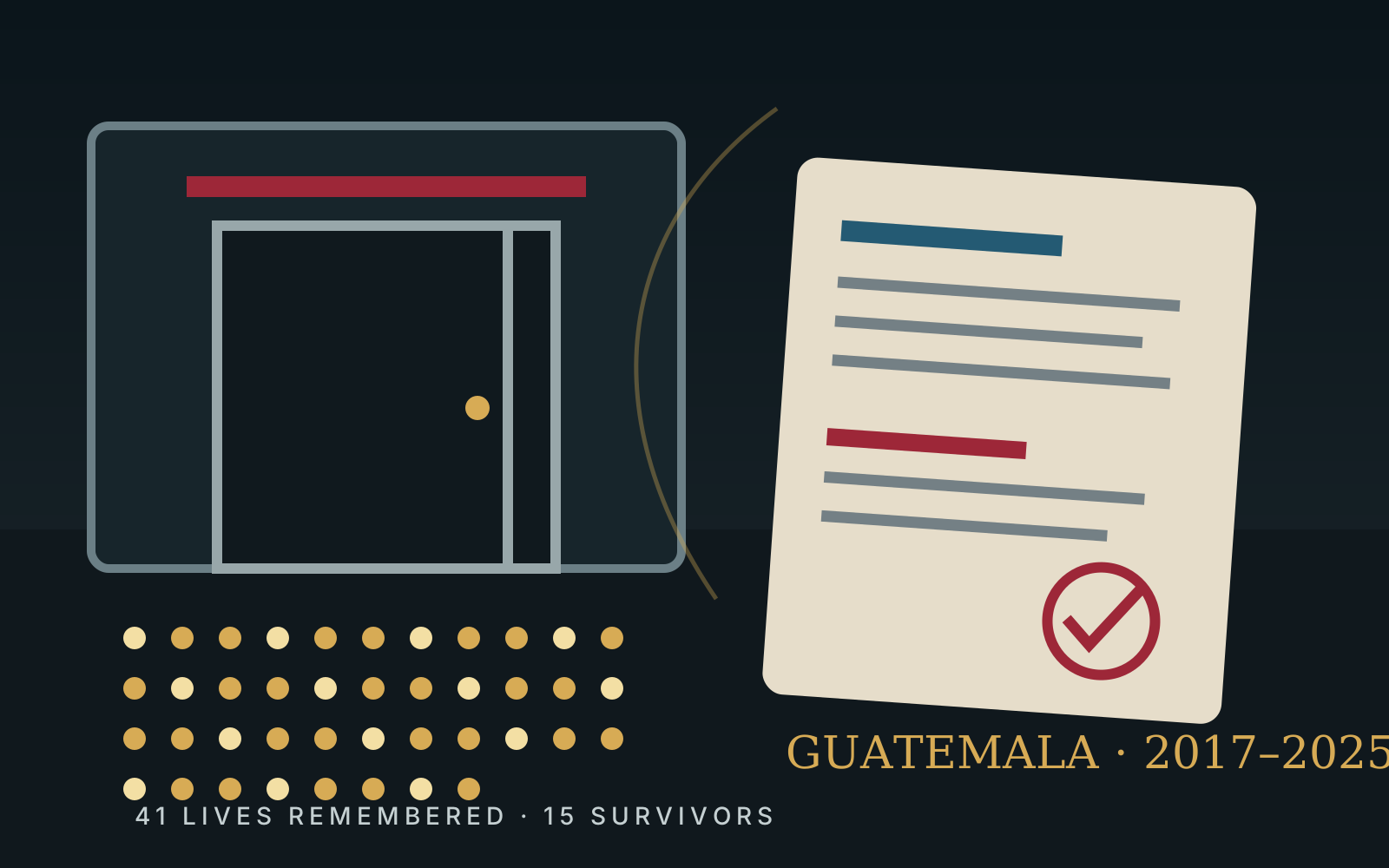
Judicial boundary: this page records the Seventh Criminal Judgment Court’s 2025 verdicts. It does not describe them as finally exhausted on appeal. One defendant was acquitted, and the judge’s request for a further investigation of former president Jimmy Morales was not a finding of criminal responsibility.
A state shelter under pressure
Hogar Seguro Virgen de la Asunción was a large state-run residential institution in San José Pinula, in the Department of Guatemala. It held children and adolescents referred through the protection system, including young people who had experienced abandonment, violence, exploitation or other serious vulnerability.
Long before the fire, the institution’s size and conditions raised questions about whether the state was providing protection or reproducing harm. Later international reviews described overcrowding, weak safeguards and allegations of abuse. The case therefore cannot be understood as an isolated building accident detached from the institution’s duty of care.
On 7 March 2017, a group of residents protested conditions and attempted to leave. Police and shelter personnel recovered many of them. Fifty-six girls were then confined in a small room. Trial reporting described that confinement as punishment and said the door was secured from outside.
The fire on 8 March
The next morning, a mattress was set alight inside the room. Evidence reported from the trial indicated that the girls hoped the smoke would force authorities to open the door. Instead, the door remained locked as the fire intensified.
Forty-one girls died. Fifteen survived with serious injuries. The Inter-American Commission on Human Rights and the United Nations have repeatedly used those same figures. Sources sometimes describe the victims collectively as children, girls or adolescents; this page follows the official 2025 judgment summary and refers to the dead and survivors as girls.
The disaster occurred on International Women’s Day, a date Guatemala later designated as a national day of remembrance for the victims. The girls were in state custody. That fact made the central question larger than who started the flame: who confined them, who held the authority to release them, who failed to respond, and which officials had allowed the conditions that produced the danger?
A long criminal process
Criminal proceedings began against officials from the shelter, the police and child-protection institutions. The process moved slowly and was divided among different groups of defendants. International observers warned against revictimizing survivors and emphasized their right to participate safely.
The Inter-American Commission reported in 2019 that the surviving girls had been returned to families or placed in recovery arrangements, while Guatemala described protection plans, inspections and steps toward deinstitutionalization. The Commission also recorded concerns that survivors had been criminalized and that proceedings contained delays and conflicts.
The principal trial eventually lasted 20 months. The prosecution presented evidence about decisions before the fire, the confinement of the girls, responsibility for the locked room and the emergency response. The court’s task was not to punish a single act in isolation, but to assess the different duties held by police and child-protection officials.
The August 2025 verdicts
On 12 August 2025, Judge Ingrid Cifuentes of the Seventh Criminal Judgment Court convicted six former officials. Guatemala’s Public Prosecutor’s Office published the sentence details the following day.
Former Social Welfare Secretary Carlos Antonio Rodas Mejía and former shelter director Santos Torres Ramírez each received 25 years. Brenda Julissa Chamán Pacay, who had headed the shelter department responsible for abuse prevention, received 17 years. Former police sub-inspector Lucinda Eva Marina Marroquín Carrillo received 13 years, former police commissioner Luis Armando Pérez Borja received 11, and former child-rights ombudsperson Gloria Patricia Castro Gutiérrez received six and was removed from office.
The convictions covered combinations of manslaughter, mistreatment of minors, breach of duty and abuse of authority. The Public Prosecutor’s Office stated that negligent-injury allegations were absorbed into the manslaughter count. Harold Augusto Flores Valenzuela, former head of the children’s office in the Attorney General’s institutional structure, was acquitted of all charges.
The Inter-American Commission’s 2025 annual report independently recorded six sentences ranging from six to 25 years and noted that the court called for a closed hearing to establish reparations while protecting the victims. Reuters likewise reported the verdict and the same casualty figures.
What the judgment did—and did not—decide
The verdict was a major adjudicated step after more than eight years. It recognized criminal responsibility across several parts of the system rather than treating the deaths as an unavoidable accident. But precision still matters.
The available official summary establishes a trial-court judgment. It does not, by itself, establish that all appeals have been concluded. For that reason, this file uses “adjudicated at trial” rather than “final conviction.” If a later appellate ruling changes any sentence or legal classification, the archive should be updated.
Judge Cifuentes also ordered an investigation into possible responsibility by former president Jimmy Morales, citing the chain of command connected to the police deployment. An investigation order is not a charge, trial or conviction. Morales is not labeled an offender in this file.
The verdict also did not erase the acquittal of Flores Valenzuela. Listing the acquitted defendant matters because the Public Prosecutor’s headline referred broadly to seven former officials, while the detailed disposition shows six convictions and one acquittal.
Survivors, remembrance and institutional reform
Guatemala closed the shelter after the fire. The state later reported a lifelong allowance for the 15 survivors, protection measures and inspections of residential care facilities. It also unveiled a memorial and designated 8 March as a national day for the victims.
The Inter-American Commission welcomed some measures while warning that institutional reform and victim participation remained incomplete. In its 2019 review, it said survivors and families needed to be involved in reparations and that broader recommendations on child protection were only partially fulfilled.
The 2025 convictions changed the accountability record, but they did not make the survivors’ recovery or the protection system’s transformation complete. The case remains a test of whether criminal judgments lead to safer care, meaningful reparations and prevention rather than becoming the endpoint of public attention.
Verified timeline
- 7 March 2017: residents protest conditions and attempt to leave Hogar Seguro; 56 girls are later confined in a room.
- 8 March 2017: a fire begins inside the locked room; 41 girls die and 15 survive with serious injuries.
- 2017–2019: criminal cases proceed; the shelter closes and national and international bodies press for protection, reparations and reform.
- 2018: Guatemala establishes 8 March as a national remembrance day for the victims.
- 2019: the IACHR records protection measures and continuing concerns about survivors’ treatment and institutional change.
- 12–13 August 2025: the Seventh Criminal Judgment Court sentences six former officials to terms from six to 25 years and acquits one defendant.
- Current classification: adjudicated at trial; appeal finality not verified; further investigation ordered, with no presumption of guilt.
Frequently asked questions
How many girls were in the locked room?
Sources reporting the trial said 56 girls were confined; 41 died and 15 survived with serious injuries.
How many people were convicted?
Six former officials were convicted in August 2025. A seventh defendant was acquitted.
What sentences were imposed?
The six terms ranged from six to 25 years, depending on each defendant’s role and convictions.
Are the convictions final?
The reviewed sources establish the trial judgment. They do not establish that every possible appeal was complete, so this page does not call the convictions final.
Was former president Jimmy Morales convicted?
No. The judge ordered a further investigation into possible responsibility; that is not a finding of guilt.
Sources and source-quality review
- Guatemala Public Prosecutor’s Office — 2025 judgment summary13 August 2025 · official names, institutional roles, prison terms, offences and acquittal.
- Inter-American Commission on Human Rights — 2025 Annual Report introductionIndependent regional-body confirmation of 41 deaths, 15 injured survivors and six sentences.
- IACHR — 2019 Guatemala compliance chapterSurvivor protection, institutional reforms, criminal-process concerns and reparations context.
- Reuters — six former officials sentenced12 August 2025 · trial reporting on confinement, verdicts and additional investigation order.
- UN Committee against Torture — Guatemala review21 November 2018 · official discussion of the 41 deaths and the locked-room circumstances.
Editorial review: the casualty figures and 2025 dispositions are cross-checked against official and independent sources. Trial convictions, acquittal and a requested investigation are not collapsed into one legal status.