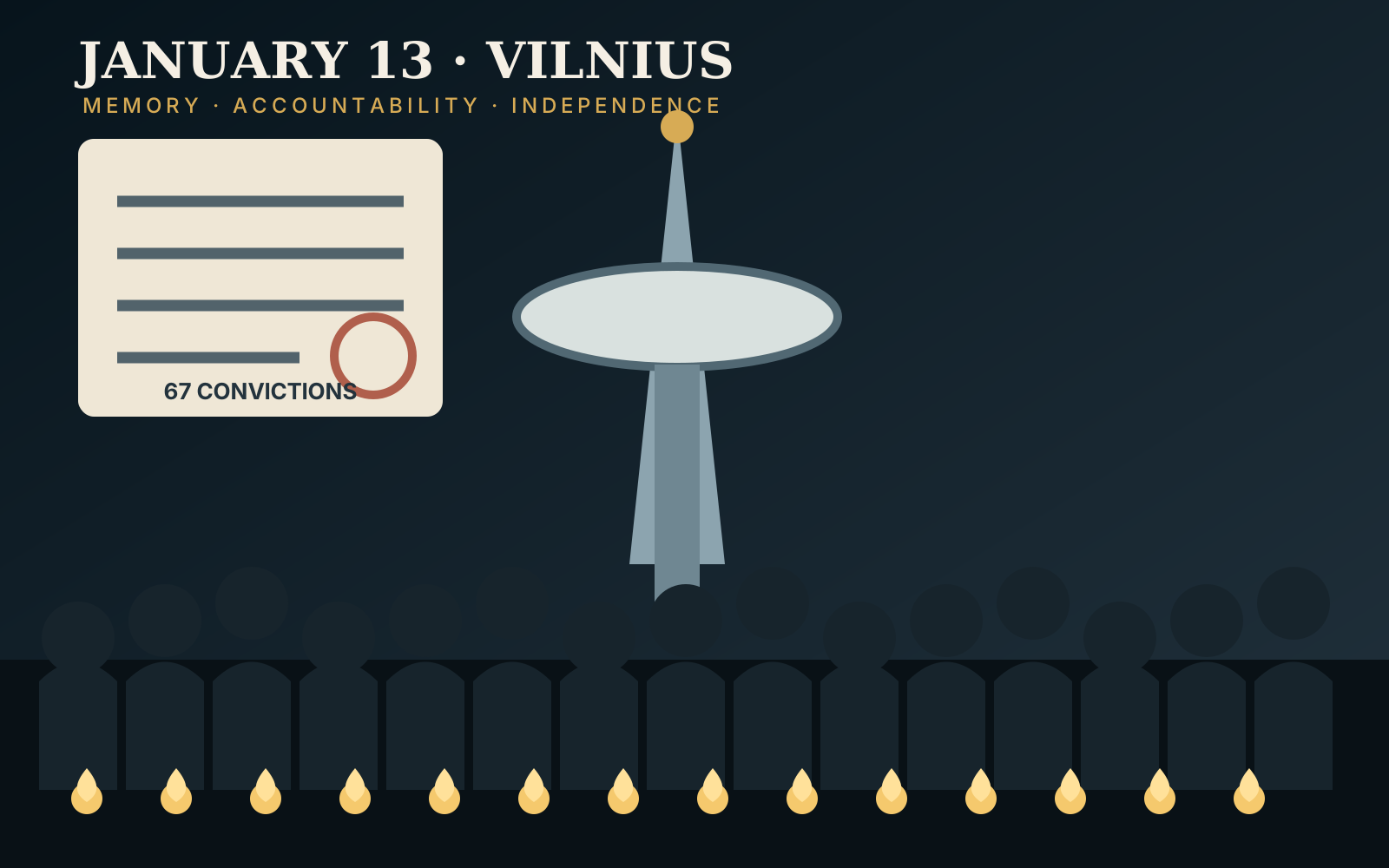
Status boundary: The 67 convictions assign criminal responsibility to the charged defendants for their participation in the Soviet operation. Most were tried in absentia. This page does not convert the judgment into a finding against every Soviet official, nor does it claim that every sentence has been enforced.
Independence under pressure
Lithuania restored its independence on 11 March 1990. The Soviet Union rejected that act and applied economic and political pressure while Soviet forces remained in the country. By January 1991, the confrontation centered on whether Lithuania's institutions and public communications could continue to operate.
Civilians gathered at strategically important sites in Vilnius, including the television tower and parliament, forming largely unarmed human barriers. Their presence became part of the defense of the restored state.
The assault on broadcasting sites
Between 11 and 13 January, Soviet troops seized the Press House and moved against the Vilnius TV Tower and the Radio and Television Committee building. Armored vehicles, firearms and military force were used during the operation. Broadcasts were interrupted, but an alternative transmission from Kaunas continued.
The attack at the television tower in the early hours of 13 January became the defining scene of the crackdown. Tanks and troops advanced through crowds who had gathered around the site. The criminal case later treated the operation as a planned attack using methods prohibited by international law.
Civilians in the line of military force
Fourteen civilians died. More than eight hundred people suffered injuries of varying seriousness, according to the Court of Appeal. The deaths and injuries arose in the context of an organized military operation against protected people and civilian sites, not an exchange between equivalent armed forces.
Commemoration in Lithuania centers the people who stood at the television tower and other institutions. The scale of injury also matters: the case was not limited to the fourteen deaths, but included the wider bodily harm and terror inflicted during the operation.
A case spanning decades
The investigation crossed the collapse of the Soviet Union, changing criminal codes, inaccessible suspects and repeated refusals of cooperation. Lithuanian prosecutors ultimately transferred the large case to Vilnius Regional Court in 2015.
The prosecution charged 67 former Soviet officials and service members from Russia, Belarus and Ukraine. Only two were present; 65 were tried in absentia. That procedure allowed Lithuania to reach judicial findings despite the defendants' absence, but it also meant that most prison terms depended on future arrest or enforcement abroad.
The 2019 judgment
On 27 March 2019, Vilnius Regional Court found all 67 defendants guilty of crimes against humanity and war crimes. The offenses included prohibited treatment of people, killing and injuring persons protected by international humanitarian law, prohibited military attack and use of prohibited means of warfare.
Former Soviet defense minister Dmitry Yazov received ten years, former KGB special-forces commander Mikhail Golovatov twelve, and former Vilnius garrison commander Vladimir Uskhopchik fourteen. The sentences varied according to role and responsibility; the judgment did not impose a single undifferentiated punishment.
Appeal and final review
The case generated dozens of appeals. On 31 March 2021, the Court of Appeal clarified factual findings, modified several sentences and awarded compensation to victims, but preserved the essential conclusion that all 67 had been reasonably convicted for the January operation.
The appellate court increased some terms, including the sentence of former USSR deputy interior minister Nikolai Demidov from ten to thirteen years. The Supreme Court then conducted cassation review and in 2022 issued the final ruling in the principal proceedings.
The in-absentia boundary
A conviction entered in absentia is still a judicial finding, but it does not mean the defendant was physically present or that the sentence has been served. The European Parliament recorded that only Yuri Mel and Gennady Ivanov stood trial in person; the others were absent.
International enforcement has remained uneven. Later litigation and extradition disputes involving individual defendants show that a final judgment and actual custody are separate questions. This archive therefore describes the case as adjudicated while avoiding the claim that all penalties were carried out.
What the verdict established
The completed proceedings established that the attack was not merely a tragic crowd-control failure. Lithuanian courts classified the conduct as international crimes and assigned responsibility across the command and operational structure represented by the defendants.
At the same time, the judgment's scope remains specific. It concerns the people charged and evidence assessed in the case. Broader political responsibility, including questions about people never indicted, should not be presented as if it were an additional criminal verdict.
Case timeline
- 11 March 1990 Lithuania declares the restoration of independence.
- 11 January 1991 Soviet forces seize the Press House in Vilnius.
- 13 January 1991 Troops attack the television tower and broadcasting facilities; fourteen civilians are killed and more than eight hundred injured.
- 2015 The Prosecutor General's Office transfers the case against 67 defendants to Vilnius Regional Court.
- 27 March 2019 All 67 defendants are convicted of war crimes and crimes against humanity.
- 31 March 2021 The Court of Appeal preserves the essential findings, changes several sentences and awards compensation.
- 2022 The Supreme Court completes cassation review in the principal January 13 case.
Questions readers ask
What happened in Vilnius on 13 January 1991?
Soviet military units attacked the Vilnius TV Tower and other broadcasting and government-related sites as Lithuania defended its restored independence.
How many people were killed?
Fourteen civilians were killed. Lithuanian appellate courts recorded more than eight hundred injured people.
How many defendants were convicted?
Vilnius Regional Court convicted 67 defendants in 2019 of war crimes and crimes against humanity.
Were most defendants present at trial?
No. Sixty-five of the 67 defendants were tried in absentia.
Did the convictions survive appeal?
Yes. The Court of Appeal preserved the essential conclusions in 2021, and the Supreme Court completed cassation review in 2022.
Did the judgment convict every person who may have influenced the assault?
No. The case adjudicated the criminal responsibility of the 67 charged defendants; it did not judicially resolve every political or command-level question.