Attribution boundary: Al-Shabaab did not claim the bombing. Somali officials, investigators and the military prosecution attributed it to the group, and the court convicted defendants described as members or facilitators. This page reports that attribution without presenting an unclaimed statement as a confession.
What happened at Zoobe junction?
On the afternoon of 14 October 2017, a truck bomb exploded at the K5 traffic junction, commonly known as Zoobe, in Mogadishu’s Hodan district. The intersection was crowded with minibuses, pedestrians, shops, restaurants, hotels and government-related offices. The blast destroyed nearby buildings and vehicles and triggered fires that complicated rescue and identification.
Human Rights Watch reported the following day that at least 230 people had been killed and hundreds wounded. That was an early count compiled while hospitals, rescue workers and families were still searching for victims. Somalia’s official figures continued to rise as deaths were confirmed and missing people were reconciled.
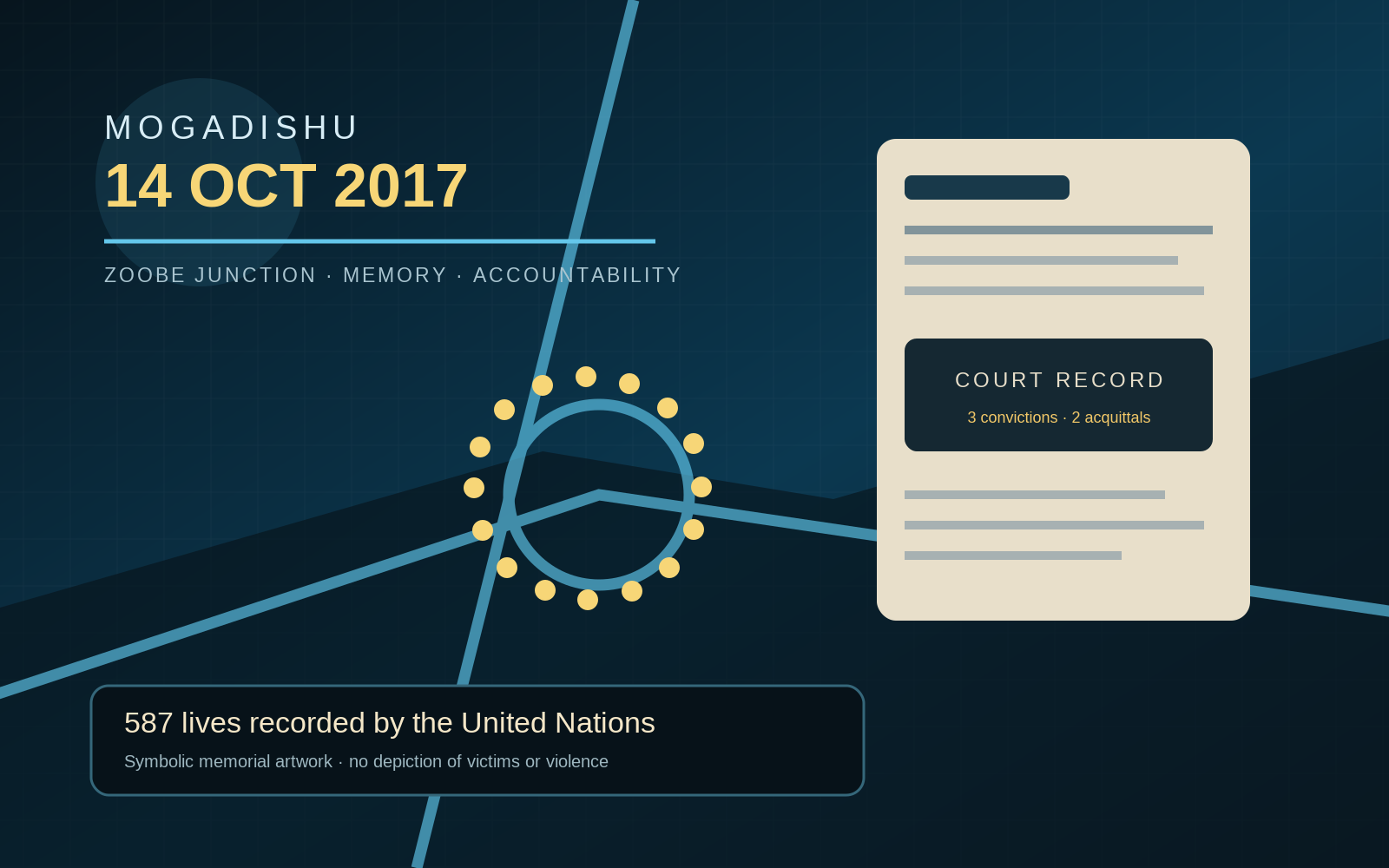
A later federal investigative committee recorded more than 500 deaths and roughly 300 injuries. United Nations statements marking the second and third anniversaries used a later total of at least 587 killed, with hundreds more injured. This page uses the UN’s later figure while preserving the fact that contemporary reports carried lower totals. The difference reflects the evolving casualty count, not separate attacks.
The victims and the scale of loss
The victims were overwhelmingly civilians using one of Mogadishu’s busiest commercial intersections. They included traders, students, transport workers, customers, hotel guests and people passing through the junction. Because the explosion and subsequent fires caused extensive destruction, some families spent days searching hospitals and temporary lists for relatives; others could not recover identifiable remains.
Somali institutions later created a national remembrance around 14 October. A memorial was established at the junction, and annual commemorations have emphasized the lives lost rather than the attacker. The UN described the bombing as the deadliest terrorist bombing in Africa involving an improvised explosive device.
The scale requires careful language. A high death toll should not become spectacle, and individual suffering should not be reduced to a statistic. The number matters because it explains the investigative burden and public response, but the archive avoids graphic detail and centers the civilians whose ordinary day was destroyed.
Who was blamed for the bombing?
No organization issued a public claim of responsibility. Somali government officials said they were certain al-Shabaab was behind the attack, and prosecutors later built their case around an al-Shabaab explosives-and-assassinations unit. Human Rights Watch initially recorded that no group had claimed responsibility and called for those who ordered the attack to be held accountable.
At the January 2018 charging hearing, prosecutors said the truck had made earlier trips between Mogadishu and Lower Shabelle and alleged that these journeys served as rehearsals and helped the driver understand security checkpoints. They identified Hussein Aden Madey as the suicide driver who died in the explosion. They also alleged that a second vehicle was intended for a coordinated attack.
These details came from prosecutors and intelligence sources and are therefore reported as allegations presented in the case. The later verdicts establish that the court accepted criminal responsibility for particular defendants; they do not turn every operational theory reported during the investigation into an independently verified fact.
The five defendants
Somali prosecutors charged five men before a military tribunal in Mogadishu. Four appeared in custody and one was charged in absentia. Hassan Aden Isak was accused of coordinating the operation and leading an al-Shabaab unit responsible for explosions and assassinations in Mogadishu. Prosecutors also alleged that he drove a second vehicle intended for another bombing that day.
Ibrahim Hassan Absuge was charged in absentia. Prosecutors described him as the owner and purchaser of the truck used at Zoobe. Abdiwali Ahmed Diriye, Mukhtar Mohamud Hassan and Abdul Abdi Warsame faced allegations that they assisted the vehicle or driver at checkpoints.
Charging allegations are not convictions. At the January hearing, each accusation remained subject to proof, and the court ultimately rejected the case against two of the five men. Preserving that distinction is essential because the same public reporting contains both the prosecution’s narrative and the final outcomes.
What did the military court decide?
On 6 February 2018, the military court sentenced Hassan Aden Isak to death. Tribunal chairman Hassan Ali Nur Shute said the court found that Isak led the militant unit behind the two vehicles used on 14 October. Reporting later said the sentence was carried out on the first anniversary of the bombing, 14 October 2018.
The court sentenced Ibrahim Hassan Absuge to life imprisonment in absentia for his role in obtaining the truck. Because he was not in custody, the judgment did not amount to his physical imprisonment. Abdiwali Ahmed Diriye received a three-year prison sentence.
Mukhtar Mohamud Hassan and Abdul Abdi Warsame were acquitted and ordered released. Their acquittals are part of the case outcome and must not be obscured by the allegations originally filed against them. The trial therefore produced differentiated results: a capital conviction, an in-absentia life sentence, a shorter prison term and two acquittals.
Why the case is only partly adjudicated
The existence of convictions gives this case substantially more judicial resolution than an attack with no identified defendant. Yet the public record does not establish a complete operational hierarchy. The suicide driver died at the scene, the person given a life sentence was tried in absentia, and the group blamed by authorities never issued a claim.
The available reports also do not provide a complete appellate record for every defendant or a comprehensive public judgment explaining all evidence. This archive therefore records the individual verdicts as established facts while avoiding the broader statement that every person who planned, supplied or ordered the bombing was brought to justice.
“Partly adjudicated” is not a judgment about the fairness of Somalia’s military justice system. It is an editorial description of the documentary boundary: several individual outcomes are known, but the entire attack and command chain are not judicially exhausted in the accessible record.
Case timeline
- 14 October 2017
A truck bomb detonates at Zoobe/K5 junction in Mogadishu. Early casualty reports rise rapidly as rescue work continues. - 15–20 October 2017
Hospitals, volunteers and authorities search for victims; the reported death toll passes 300. - December 2017
A government-appointed committee reports 512 deaths and 316 injuries. Later UN commemorations use a toll of at least 587 killed. - 1 January 2018
Five men are publicly charged before a military tribunal; four are in custody and one is absent. - 6 February 2018
The court sentences Hassan Aden Isak to death, Ibrahim Hassan Absuge to life in absentia and Abdiwali Ahmed Diriye to three years; two defendants are acquitted. - 14 October 2018
News reporting says Isak’s death sentence is carried out on the first anniversary of the attack. - 14 October 2019 and 2020
The United Nations commemorates the victims and records at least 587 deaths. - 14 October 2026
The archive verifies the known verdicts but finds no complete public accounting of every operational participant.
What remains unanswered?
Public reporting does not fully explain who selected the final detonation point, whether the original intended target changed after the truck encountered security checks, or which senior figures—if any—ordered the operation. Prosecutorial accounts addressed logistics, but the accessible verdict reporting is not a complete evidentiary record.
The evolving death toll also illustrates the difficulty of identification after a mass-casualty explosion. The later UN figure is the strongest institutional total located, but it cannot restore the identities and circumstances of every victim to the public record.
Future court documents, declassified investigative material or credible Somali reporting could clarify the missing parts. Until then, the most defensible account is one that recognizes both the convictions and the limits of those proceedings.
Frequently asked questions
How many people were killed?
Early counts rose from 230 to more than 500. United Nations anniversary statements later recorded at least 587 deaths and hundreds of injuries.
Did al-Shabaab claim the attack?
No public claim was issued. Somali authorities attributed the bombing to al-Shabaab, and the military prosecution described the convicted defendants as connected to the group.
Who was convicted?
Hassan Aden Isak received a death sentence, Ibrahim Hassan Absuge received life imprisonment in absentia and Abdiwali Ahmed Diriye received three years. Mukhtar Mohamud Hassan and Abdul Abdi Warsame were acquitted.
Was the death sentence carried out?
News reports said Hassan Aden Isak was executed on 14 October 2018. The page attributes this to published reporting rather than implying independent access to an execution record.
Why is the case not called fully solved?
The trial produced individual verdicts, but the suicide driver died, one defendant remained absent, al-Shabaab never claimed the attack and the complete operational chain was not publicly adjudicated.
Sources and verification notes
- United Nations in Somalia — second-anniversary statementLater institutional casualty total of at least 587 deaths and the attack’s historical classification.
- UNSOM and UN Human Rights Office — Protection of Civilians reportOfficially recorded 512 deaths and 316 injuries as of 1 December 2017 and attribution by Somali officials.
- Voice of America — five defendants chargedNames, allegations, vehicle history, checkpoint account and distinction between custody and an in-absentia charge.
- Voice of America — military-court verdicts, 6 February 2018Death sentence, life term in absentia, three-year sentence and two acquittals.
- Human Rights Watch — contemporary civilian-impact reportAttack location, early casualty count, civilian context and absence of an immediate claim.
- U.S. Department of State — Somali police investigation contextContemporaneous institutional description of the two bombings and subsequent crime-scene work.
Verification date: 14 October 2026. Casualty totals are dated and attributed because they changed during the recovery process. Allegations, convictions, acquittals and group attribution are reported as separate findings.