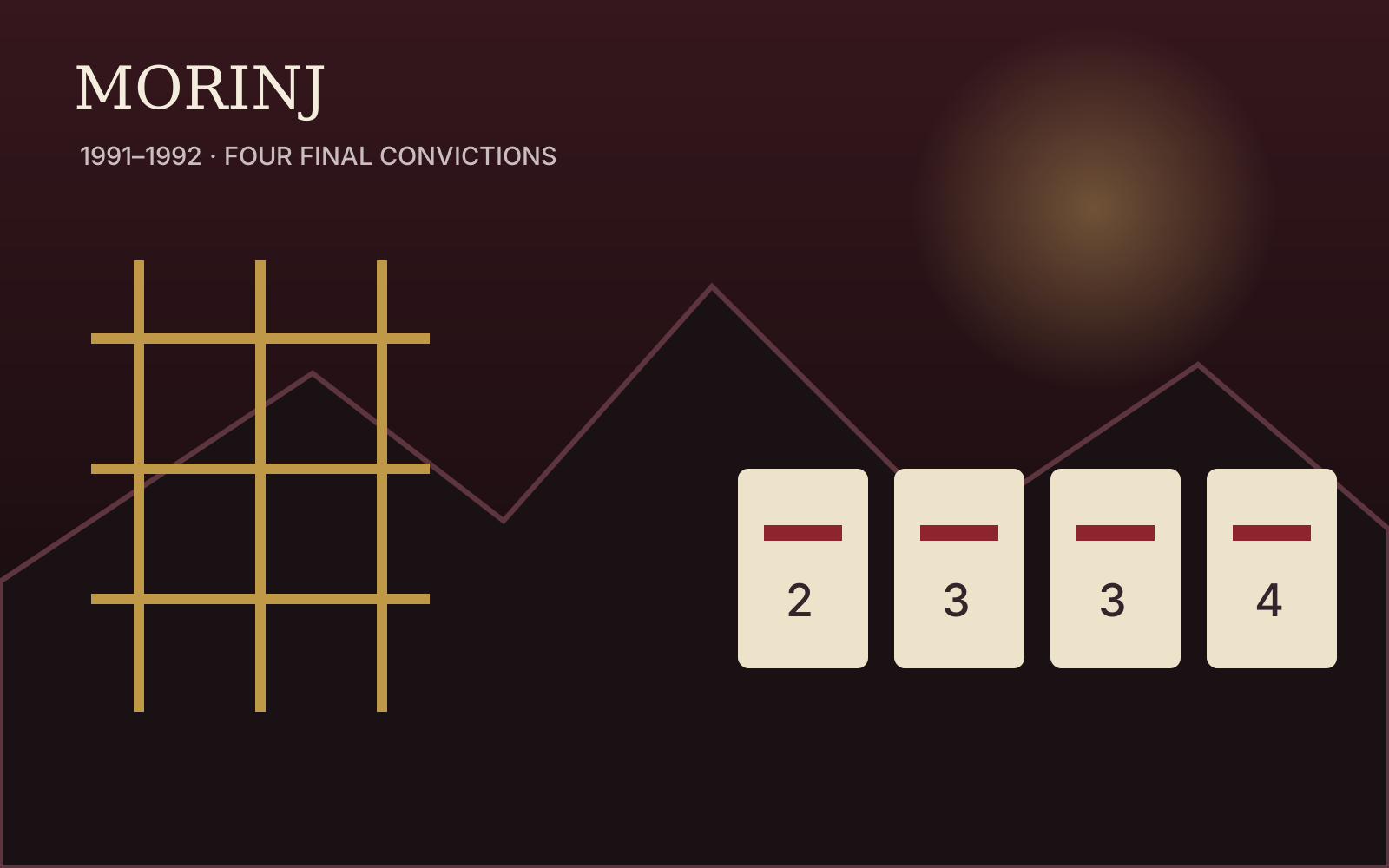
Legal boundary: four former Yugoslav People’s Army reservists received final convictions for abusing prisoners at Morinj. Two defendants were acquitted. The verdict established direct criminal responsibility but did not resolve every allegation about senior officers or the wider detention system.
The detention site
The Yugoslav People’s Army opened a collection and detention center at Morinj, near Kotor, on 3 October 1991 as fighting around Dubrovnik intensified. Croatian civilians and captured members of Croatian forces were brought across the border and held there until August 1992.
Published totals differ because sources count the camp population, named victims in litigation and compensated claimants differently. A Montenegrin civil-society account says 292 people passed through the camp; court-related reporting describes more than 160 or at least 169 abused detainees. This archive does not collapse those categories into one supposedly exact victim count.
Abuse inside Morinj
Former detainees described beatings, humiliation, threats, inadequate conditions and other cruel treatment. The final Montenegrin judgment established physical abuse of Croatian prisoners as war crimes. The site was not a rumor or an untested political allegation: it became one of the rare Montenegro war-crimes cases to produce final convictions.
The victims included prisoners of war and civilians taken from the Dubrovnik and Konavle area. No death toll is assigned to the camp because the convictions concerned mistreatment, not a proven series of killings at the facility.
A long and repeatedly retried case
Montenegro indicted six former JNA members in 2008. The Higher Court in Podgorica first convicted all six in 2010, but appellate review led to repeated proceedings. A third first-instance judgment in July 2013 convicted four men and acquitted two.
Ivo Gojnić received two years, Boro Gligić three years, Špiro Lučić three years and Ivo Menzalin four years. Mlađen Govedarica and Zlatko Tarle were acquitted. In April 2014 the Court of Appeal upheld the judgment, making the four convictions final.
What the verdict did not reach
Human Rights Action argued that prosecutors treated the violence as isolated misconduct by lower-ranking perpetrators instead of examining an organized system and the possible responsibility of superiors. The final judgment is therefore meaningful but limited: four direct perpetrators were punished, while the command structure was not comprehensively adjudicated.
In February 2026 Montenegro’s State Prosecutor’s Office disclosed renewed investigative work on Morinj and other war-crimes files. That step does not erase the final convictions or prove new suspects guilty. It shows that the state itself does not treat the broader accountability question as closed.
Memorial and contested remembrance
Officials from Montenegro and Croatia unveiled a memorial plaque at the former camp in October 2022, honoring detained Croatian civilians and defenders. The gesture was welcomed by victims’ advocates, although the plaque’s legal authorization and wording became subjects of domestic political dispute.
The arguments around the memorial should not obscure the court record. The camp operated, detainees were abused and four men were finally convicted. Responsible commemoration can acknowledge those facts while separately discussing the plaque’s legal status.
Timeline
- 3 October 1991 — the Morinj detention center begins operating.
- 18 August 1992 — the period identified on the later memorial plaque ends.
- 2008 — prosecutors indict six former JNA members.
- 15 May 2010 — the first trial convicts all six; appellate proceedings follow.
- 31 July 2013 — four defendants are convicted and two acquitted after retrial.
- April 2014 — the Court of Appeal confirms the judgment.
- 10 October 2022 — Montenegro and Croatia unveil a memorial plaque.
- February 2026 — prosecutors report renewed investigative work on Morinj.
Frequently asked questions
Is the case solved?
The four final convictions are adjudicated. The page keeps a qualification because senior responsibility was not resolved and renewed investigation was reported in 2026.
Were people killed at Morinj?
The published convictions centered on physical abuse and inhuman treatment. This archive does not add an unverified death count.
Sources
- RTCG — Morinj judgments confirmedApril 2014 · final convictions and prisoner record.
- Human Rights Action — Morinj memorial and final judgment10 October 2022 · names, sentences and final legal status.
- Human Rights Action — Third first-instance judgment31 July 2013 · verdict and concerns about command responsibility.
- Government of Montenegro — Morinj memorial unveiled10 October 2022 · official commemoration and dates of the camp.
- Centre for Civic Education — Morinj camp and memorial13 October 2022 · reported camp population and final appellate outcome.
- Vijesti — Prosecutors renew Morinj investigationFebruary 2026 · current investigative status and at least 169 abused detainees.
Source review completed: 7 October 2026.