A meeting at Olivier Café
On January 6, 2016, Wayan Mirna Salihin met Jessica Kumala Wongso and Hanie Boon Juwita at Olivier Café inside the Grand Indonesia shopping complex in Central Jakarta. Contemporary reporting from Indonesia's ANTARA news agency records that Wongso arrived first and ordered drinks, including a Vietnamese iced coffee that Mirna later drank.
Mirna became acutely ill soon after tasting the coffee and was taken for medical help before being transported to Abdi Waluyo Hospital, where she died. Her family reported the death as suspicious, and police began an investigation that quickly centered on the drink and the circumstances at the café.
The prosecution case and the evidentiary dispute
Investigators and prosecutors alleged that cyanide had been placed in Mirna's coffee and accused Wongso of deliberately causing her death. The prosecution presented testimony from café employees, forensic specialists and digital-evidence experts, along with CCTV footage and circumstantial evidence about the sequence of events at the table.
The case did not rest on an eyewitness who said they saw Wongso put poison into the drink. ANTARA's detailed account of the trial states that café employees did not testify to seeing her add anything to the glass. The defense also called experts who challenged the prosecution's toxicology interpretation, questioned whether the cause of death could be established without a full autopsy and disputed aspects of the CCTV analysis.
That conflict is central to understanding the case. The final legal result was a murder conviction, but the trial contained significant adversarial disagreement over how the forensic evidence should be interpreted. A responsible summary therefore separates what the courts ultimately accepted from what the defense continued to contest.
Trial and 2016 conviction
Wongso's trial began in June 2016 at the Central Jakarta District Court and drew intense national attention. Over months of hearings, prosecutors argued that the death was a planned killing, while the defense maintained that the evidence did not prove Wongso had poisoned Mirna and that alternative forensic interpretations had not been excluded.
On October 27, 2016, the court found Wongso guilty of premeditated murder under Article 340 of Indonesia's Criminal Code and imposed a 20-year prison sentence. The sentence matched the prosecution's request. Wongso and her lawyers announced that they would challenge the judgment.
Appeals and the Supreme Court record
The case proceeded through Indonesia's appellate system. In June 2017, the Supreme Court rejected Wongso's cassation challenge, leaving the 20-year sentence in place. The Supreme Court's public decision directory lists the cassation as case 498 K/PID/2017 and identifies the judgment as having permanent legal force.
Wongso later sought judicial review. The Supreme Court directory lists the first review as case 69 PK/Pid/2018, decided on December 3, 2018. That effort also failed, so the underlying conviction remained unchanged.
Parole did not erase the conviction
On August 18, 2024, Indonesia's Directorate General of Corrections announced that Wongso had been released on parole under a Ministry of Law and Human Rights decision. Parole changed her custodial status; it did not overturn the murder judgment.
ANTARA reported that parole required continued reporting and correctional supervision, with guidance obligations extending through 2032. After leaving prison, Wongso and her legal team continued to pursue a new judicial review and maintained that she had not committed the crime.
A second judicial review was rejected in 2025
On August 14, 2025, the Supreme Court rejected Wongso's second judicial-review application, decision 78 PK/PID/2025. ANTARA reported the result the following day, noting that the defense had relied on claimed new evidence and alleged judicial error. The rejection meant that Wongso continued to be legally regarded as convicted of Mirna's murder.
As of this archive's August 2026 review, the conviction has not been overturned. Because the judgment remains final despite multiple rounds of challenge, this file is classified as solved in the legal/adjudicative sense.
Why the case remains debated
The Mirna Salihin case became one of Indonesia's most discussed modern criminal trials because the legal certainty of the verdict sits alongside continuing public debate about the proof. The absence of a direct eyewitness to the alleged poisoning, the defense's challenge to the toxicology evidence and disagreement over the interpretation of video evidence have all remained part of that debate.
Those disputes do not change the current legal status, but they matter when describing the case accurately. Crime by Region therefore avoids presenting contested forensic propositions as independently established facts. The archive records the court's conclusion, the defense position and the later procedural history separately.
Timeline
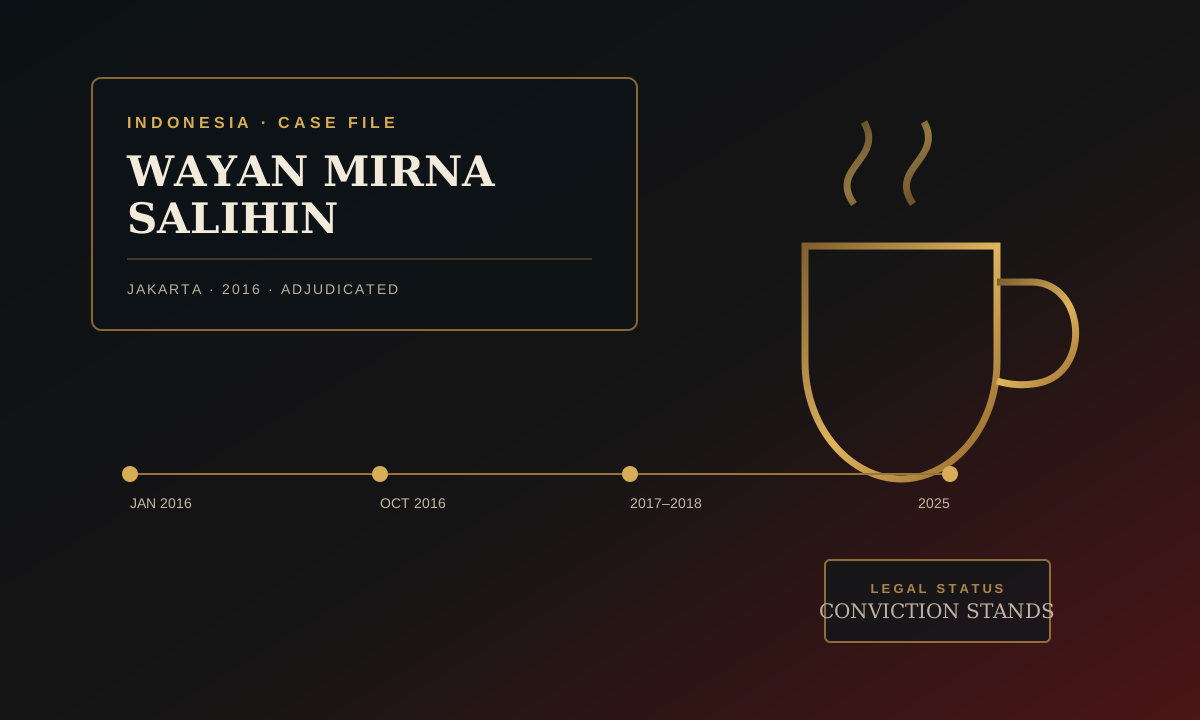
January 6, 2016: Wayan Mirna Salihin becomes critically ill after drinking Vietnamese iced coffee at Olivier Café in Central Jakarta and later dies.
January 30, 2016: police arrest Jessica Kumala Wongso after investigators designate her a suspect.
June 15, 2016: Wongso's murder trial begins at the Central Jakarta District Court.
October 27, 2016: the court convicts Wongso of premeditated murder and sentences her to 20 years in prison.
June 2017: the Supreme Court rejects her cassation challenge; the conviction remains in force.
December 3, 2018: the Supreme Court rejects the first judicial-review petition.
August 18, 2024: Wongso is released on parole under correctional supervision.
August 14, 2025: the Supreme Court rejects a second judicial-review application in decision 78 PK/PID/2025.
Current status
The criminal judgment against Jessica Kumala Wongso remains legally valid. She is no longer incarcerated after receiving parole in 2024, but parole is not an acquittal or reversal. Wongso continues to deny killing Mirna, while the Indonesian court record continues to treat the 2016 premeditated-murder conviction as final.
Sources
- Supreme Court of the Republic of Indonesia — decision directory entries for cases 498 K/PID/2017 and 69 PK/Pid/2018
- ANTARA — detailed chronology from Mirna's death through the October 2016 verdict, October 28, 2016
- ANTARA — Supreme Court rejects Wongso's cassation challenge, June 22, 2017
- ANTARA English — Directorate General of Corrections confirms parole, August 18, 2024
- ANTARA — Supreme Court rejects the second judicial review, August 15, 2025