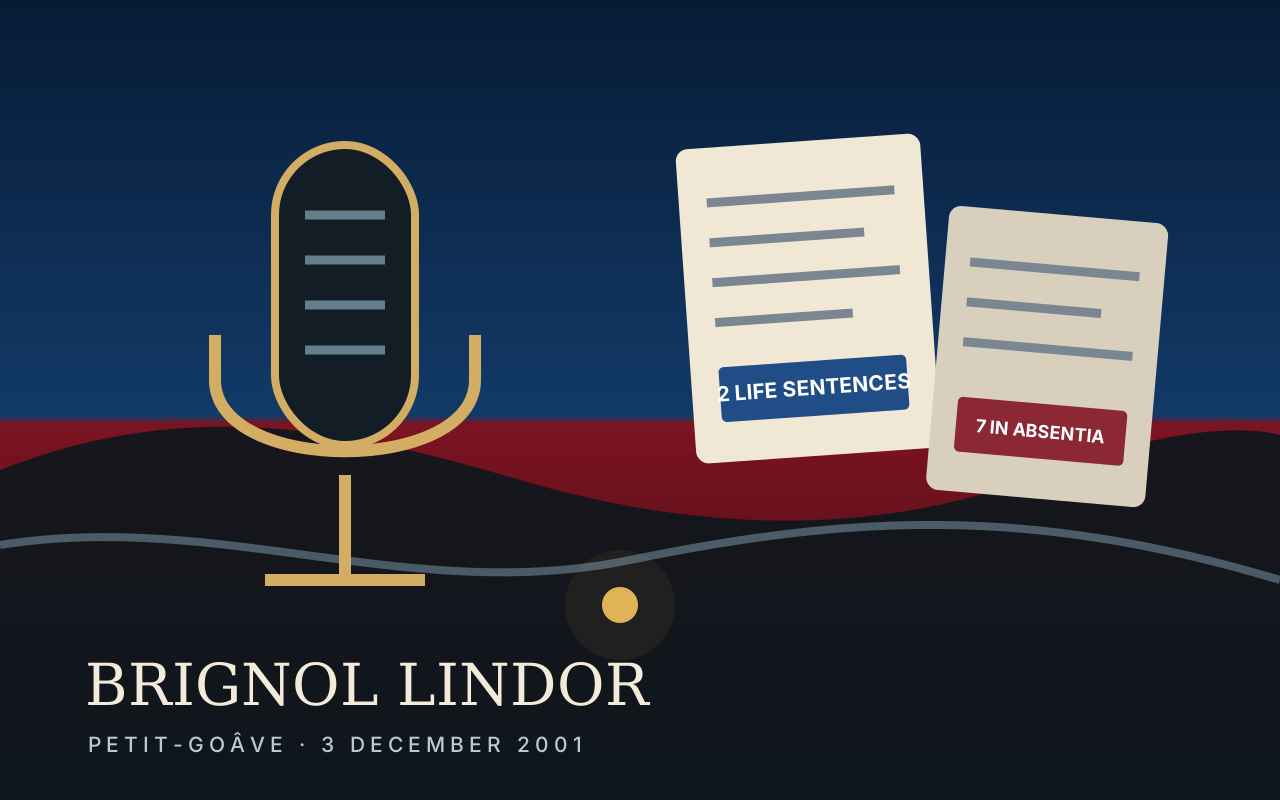
Status boundary: convictions establish responsibility for the people adjudicated. They do not prove allegations against people who were not tried, and the in-absentia verdicts did not place the seven defendants in custody.
A radio journalist in Petit-Goâve
Brignol Lindor was the news director of Radio Echo 2000 and hosted the station’s political talk program Dialogue. Reporters Without Borders described him as a journalist, lawyer and teacher who tried to remain outside Haiti’s factional disputes. He was 31 when he was killed.
CPJ reported that Lindor had received threats after inviting members of the opposition coalition Democratic Convergence onto his program. That connection is well documented as context, but the archive distinguishes public threats, organizational ties and allegations from findings reached against individual defendants.
Threats and the “zero tolerance” context
In June 2001, President Jean-Bertrand Aristide announced a “zero tolerance” anti-crime policy. According to CPJ and RSF, Petit-Goâve deputy mayor Dumé Bony later said publicly that the policy should be applied to Lindor. The statement became a central focus of press-freedom reporting after the murder.
That public record supports the conclusion that Lindor faced politically charged threats. It does not, without a judgment, establish that every official or political figure named in reporting ordered his death. Later calls for an investigation into possible instigators show that the question remained open.
The killing on 3 December 2001
On the morning of 3 December, Lindor was intercepted near L’Acul, outside Petit-Goâve, by members of a local armed group known as Domi Nan Bwa. The mob killed him. Sources describe severe violence; this account does not reproduce graphic detail because it is unnecessary to understand the case.
The murder followed the 2000 killing of Radio Haïti-Inter director Jean Dominique and intensified fear among Haitian journalists. RSF reported that the case became a symbol of worsening press freedom and of the difficulty of pursuing politically sensitive crimes.
A stalled investigation
The early investigation moved slowly. RSF’s 2002 inquiry said only four suspected participants had been jailed nine months after the murder, despite many people being identified by witnesses or other sources. OAS reporting tracked the judicial process and the Haitian government’s response.
CPJ later said the case had stalled for almost six years. An independent commission of Haitian journalists helped recover parts of a court file that had been missing and forwarded them to investigators in September 2007. Four defendants were arrested the following month, allowing a trial to proceed.
The 2007 trial
From 10 to 12 December 2007, four defendants were tried in Petit-Goâve. The court convicted Jean Rémy Démosthène and Joubert Saint Juste and sentenced each to life imprisonment. A third defendant, Simon Cétouté, was acquitted because of mistaken identity. A new investigation was ordered for the fourth, Fritzner Doudoute, because of a procedural problem.
The court also issued warrants for other Domi Nan Bwa members and directed further investigation that could reach possible instigators, including former officials. CPJ welcomed the two convictions while stressing that all responsible parties still needed to be brought to justice.
Seven convictions in absentia
On 23 January 2008, seven additional defendants were convicted in absentia. RSF initially described the verdict as a potential turning point against impunity. But a conviction in absentia did not mean the defendants had been arrested or that the full circumstances had been tested with them present.
By the seventh anniversary in December 2008, RSF reported that the seven remained at large and that presumed instigators had never been tried. The two life sentences and seven in-absentia convictions are therefore substantial judicial outcomes, but they do not form a complete accountability record.
Why the case remains partially unresolved
This archive marks the case partially adjudicated. The convictions are real and should not be erased by calling the entire matter simply “unsolved.” At the same time, later case-specific reporting located for this review did not document the arrest and retrial of the seven absent defendants or a trial of alleged instigators.
The label is narrower than a claim of total impunity and more accurate than “fully solved.” It records what courts established, what remained outside custody and what was still only alleged.
Timeline
- June 2001 — Haiti’s government announces a “zero tolerance” anti-crime policy.
- Late 2001 — Lindor receives threats tied to his political broadcasts; a local official publicly invokes “zero tolerance” against him.
- 3 December 2001 — Lindor is killed near Petit-Goâve.
- 2002 — RSF documents slow arrests and concerns about alleged instigators.
- September 2007 — Journalists recover and forward parts of the missing court file.
- 10–12 December 2007 — Two men receive life sentences; one defendant is acquitted and another faces a renewed inquiry.
- 23 January 2008 — Seven defendants are convicted in absentia.
- 3 December 2008 — RSF reports the seven still at large and alleged instigators untried.
Frequently asked questions
Who was Brignol Lindor?
He was news director at Radio Echo 2000 and host of the political talk program Dialogue.
When was he killed?
He was killed near Petit-Goâve on 3 December 2001.
Was anyone convicted?
Two men received life sentences in December 2007, and seven more defendants were convicted in absentia in January 2008.
Was every defendant convicted?
No. One 2007 defendant was acquitted because of mistaken identity, and a renewed inquiry was ordered for another.
Why is the case not fully solved?
Later reporting said the seven defendants convicted in absentia remained at large and alleged instigators had not been tried.
What is the current classification?
Partially adjudicated: convictions are documented, while the wider responsibility record remained unresolved in the latest case-specific reporting located.
Sources and source-quality review
The account cross-checks CPJ’s trial reporting with RSF’s 2002 investigation and 2007–2008 case updates, plus OAS/IACHR records. Accusations against possible instigators are attributed and not presented as verdicts.
- Committee to Protect Journalists — Two convicted in Lindor’s murder14 December 2007 · threats, trial outcomes, warrants and further investigation
- Reporters Without Borders — “Zero tolerance” inquirySeptember 2002 · victim profile, chronology and early investigation
- Reporters Without Borders — Seven convicted in absentiaJanuary 2008 · second verdict and custody limitation
- Reporters Without Borders — Convicted defendants still at large3 December 2008 · seven fugitives and alleged instigators untried
- IACHR Special Rapporteur for Freedom of Expression — Haiti observations4 October 2007 · Lindor case within journalist-murder investigations
- RSF annual report via Refworld13 February 2008 · trial and recovered case-file context
Status note
Reviewed through 30 September 2026. The latest detailed case-specific source located was the December 2008 RSF update; absent newer authoritative disposition records, the page does not assume that remaining defendants were captured or alleged instigators tried.
← Return to the Haiti archive