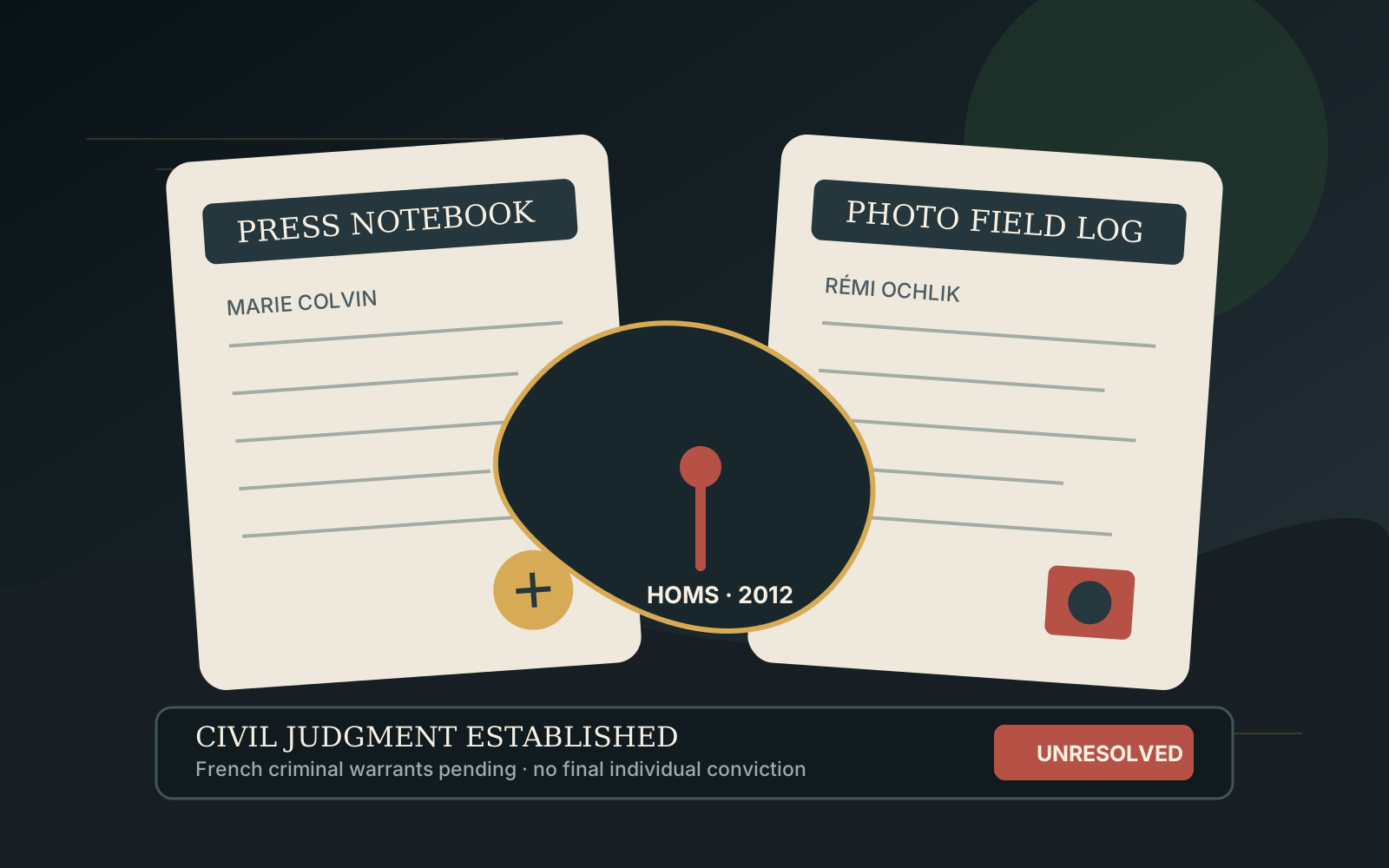
Status boundary: The 2019 U.S. decision is a civil default judgment against the Syrian state, not a criminal conviction of an individual. The seven French arrest warrants issued in 2025 are accusations and custody instruments, not findings of guilt.
Two journalists in Baba Amr
Marie Colvin was an American correspondent for The Sunday Times of London, known for reporting the human cost of conflict. Rémi Ochlik was a French photojournalist and founder of IP3 Press whose work had documented Haiti, the Arab uprisings and the war in Libya. Both entered Syria to report from Baba Amr, a district of Homs then under siege by government forces.
The improvised media center was not only a workplace for foreign reporters. Syrian media activists used it to document conditions inside the besieged district and connect residents with outside news organizations. Colvin broadcast live interviews on the night before her death. Her reporting described civilian casualties and the pressures on a makeshift medical clinic.
On the morning of 22 February, rockets struck the building. Colvin and Ochlik died. French journalist Edith Bouvier, British photographer Paul Conroy and Syrian interpreter Wael al-Omar were injured. Other journalists and activists escaped, and local networks later helped survivors leave the district through dangerous routes.
The attack and immediate record
Contemporary reports established the basic sequence: government forces were shelling Baba Amr; a rocket hit the informal press center; and a second strike followed as people tried to leave. Initial public accounts could not determine whether the building had been deliberately targeted or struck during wider bombardment. That distinction became the central factual issue in later litigation and investigation.
The Syrian government denied deliberately targeting journalists and offered shifting public accounts. The victims' colleagues and survivors described the strike as precise and linked it to the reporters' broadcasts. Those opposing claims were not resolved by news coverage alone. Later evidence—including insider testimony, intercepted communications, documents and ballistic analysis—was assessed in separate U.S. civil and French criminal processes.
This file does not describe every death during the siege of Homs. It stays with the defined attack on the media center and the five journalists or interpreters killed or injured there. Broader allegations against Syrian forces provide context but are not silently converted into findings in this case.
The U.S. civil case
Colvin's relatives filed Colvin v. Syrian Arab Republic in federal court in Washington, D.C. The claim used the terrorism exception to the Foreign Sovereign Immunities Act, which can permit civil suits against designated state sponsors of terrorism in circumstances defined by U.S. law. Syria did not appear to defend the case, so the court evaluated the plaintiffs' evidence in a default-judgment procedure.
On 30 January 2019, Judge Amy Berman Jackson found the Syrian Arab Republic liable for Colvin's extrajudicial killing. The court concluded that Syrian officials had tracked journalists' communications, learned the media center's location and launched a targeted artillery attack. It awarded compensatory damages to family members and punitive damages against the state.
The decision is a significant judicial finding, but its form matters. It is civil, not criminal; it binds the defendant state in that lawsuit; and it was entered after Syria failed to appear. It did not convict Bashar al-Assad or any named officer. The evidentiary record can inform public understanding without erasing these jurisdictional and procedural boundaries.
Rémi Ochlik and the French investigation
The U.S. case was brought by Colvin's family and centered on her death. Ochlik's killing and the injuries to Bouvier, Conroy and al-Omar arose from the same attack, but accountability also developed through French proceedings. France opened a judicial investigation in which Ochlik's family, Bouvier and rights organizations participated.
Investigators examined the military chain of command, surveillance capabilities, witness testimony and ballistic evidence. According to the Syrian Center for Media and Freedom of Expression and reporting on the investigation, judges concluded that the press center was deliberately targeted as part of an effort to stop foreign reporting from Baba Amr.
That investigative conclusion does not itself equal a trial verdict. French investigating judges decide whether evidence supports coercive measures and a possible prosecution; a trial court determines guilt if defendants are brought before it.
Seven French arrest warrants
In August 2025, French investigating judges issued arrest warrants for seven former senior Syrian officials. Public reporting identified Bashar al-Assad, Maher al-Assad, Ali Ayoub, Ali Mamlouk, Ghassan Bilal, Mohammed Dib Zaitoun and Rafiq Mahmoud Shahadah. They were accused of complicity in war crimes and crimes against humanity connected to the attack.
The warrants marked a major procedural step because they identified alleged responsibility at senior command levels. They did not produce arrests, extraditions or convictions at the time of the sources reviewed. The accused retain the presumption of innocence in any eventual criminal trial.
Bashar al-Assad had left office and fled Syria in December 2024. A French high-court ruling in a different case had clarified that new warrants could be considered after he ceased to be a sitting head of state. That legal development helps explain the timing, but it is separate from proof about the Baba Amr attack itself.
Current accountability status
The record now has two distinct layers. First, a U.S. federal court established civil liability of the Syrian state for Colvin's killing. Second, French criminal investigators issued warrants against seven individuals for alleged complicity in the attack that killed Colvin and Ochlik and injured others.
No reliable source reviewed through September 2026 reported that any of the seven had been tried or convicted for this attack. The correct present status is therefore mixed: the state-liability judgment is established, while individual criminal accountability remains pending.
This distinction protects both accuracy and the rights of victims. Calling the case “unsolved” without qualification would ignore a substantial judicial finding. Calling it “solved” would imply an individual criminal result that does not yet exist.
Timeline
- February 2012
Colvin, Ochlik and other journalists reach Baba Amr to report on the siege. - 21 February 2012
Colvin gives live broadcasts describing civilian suffering and the medical emergency. - 22 February 2012
Rockets strike the informal media center. Colvin and Ochlik are killed; Bouvier, Conroy and al-Omar are injured. - 2016
Colvin's family files the U.S. civil action against Syria. - 30 January 2019
The federal court finds Syria civilly liable for Colvin's extrajudicial killing. - August 2025
French judges issue seven arrest warrants concerning alleged complicity in the attack. - September 2026
No final individual criminal conviction is located; the French proceedings remain pending.
What remains unanswered
The principal open question is whether the French warrants will lead to custody and a criminal trial. An eventual court would have to evaluate each accused person's conduct, intent and legal responsibility separately. The U.S. civil findings cannot substitute automatically for that criminal process.
There is also a documentary question about the full operational chain behind the shelling. Investigators have described surveillance and command structures, but a public criminal judgment has not yet tested the whole record. Future reporting should distinguish newly disclosed evidence from adjudicated fact.
Case FAQ
Why name both Colvin and Ochlik?
Both journalists were killed in the same attack. The U.S. lawsuit focused on Colvin, but the case record and French investigation concern Ochlik and the injured survivors as well.
Did Syria participate in the U.S. lawsuit?
No. Syria did not appear, and the court entered a default judgment after evaluating evidence submitted by the plaintiffs.
Were the seven officials convicted?
No. French arrest warrants were issued, but no trial or final conviction for the attack was located.
Is this page about every crime during the siege of Homs?
No. It documents the defined media-center attack and the accountability proceedings connected to it.