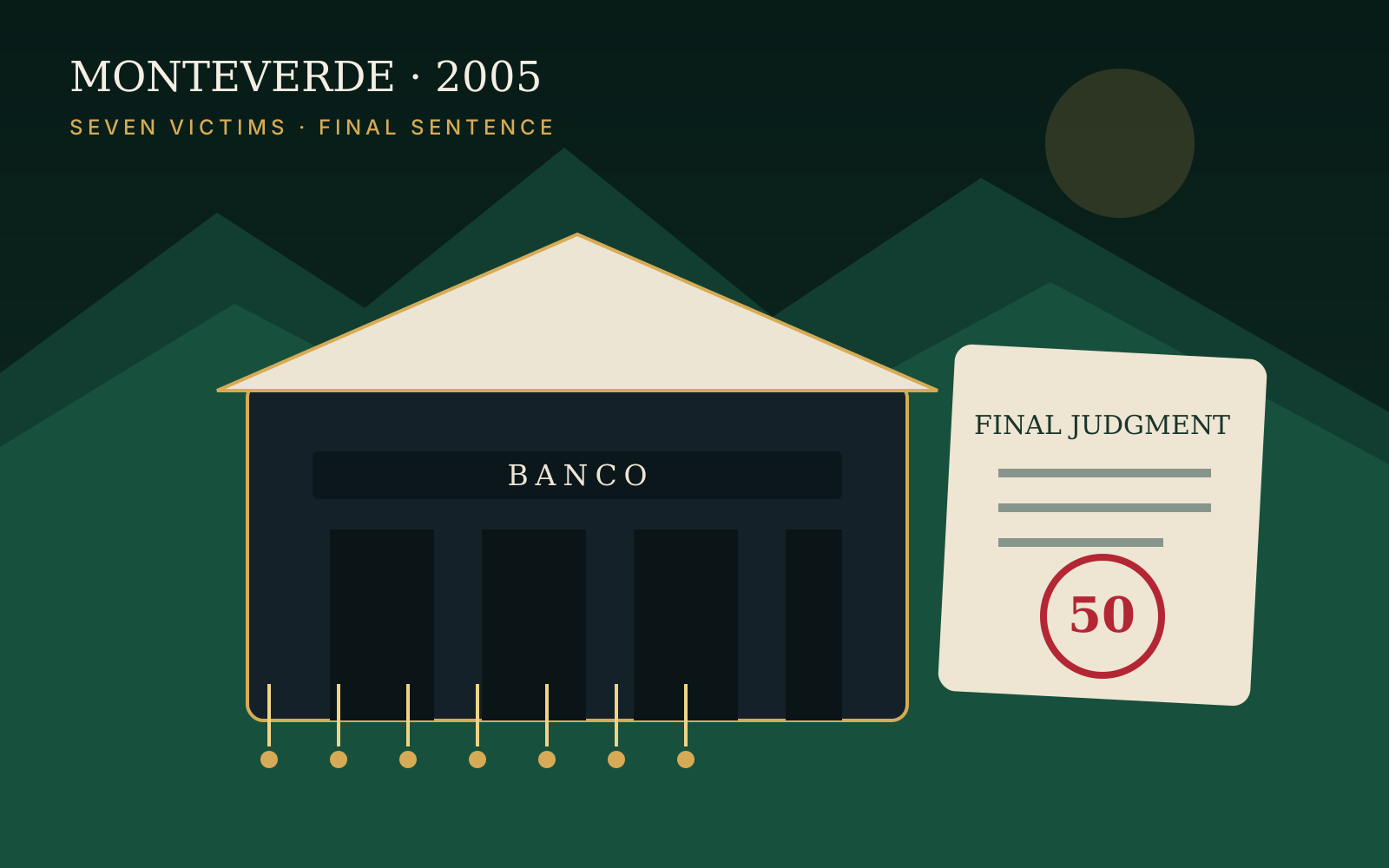
Counting boundary: nine people died during the incident, but two were members of the three-man robbery group. This page identifies seven victims and does not fold the two dead assailants into the victim count. Reports also vary slightly on the number of hostages and injured people; those differences are preserved below.
The attack on the Monteverde branch
At about 3:26 p.m. on 8 March 2005, three armed brothers approached the Banco Nacional branch in Santa Elena, Monteverde. Their attempted robbery collided almost immediately with the bank’s private security. Two of the brothers—Santos Agenor Hurtado Martínez and Santos Mayori Cruz Martínez—were killed near the entrance. Erlyn Hurtado Martínez was wounded but entered the building.
The surviving assailant carried military-style firearms, including an AK-pattern rifle. Inside, employees and customers were trapped. Court reporting later described indiscriminate gunfire and direct attacks on people who posed no threat. Hurtado contacted emergency services and negotiations began.
Official judicial reporting described 1,688 minutes of terror. Contemporary sources counted 28 people retained for more than 30 hours and more than 15 injured; later reconstructions commonly described 31 or 32 hostages, about 28 hours and 17 to 20 injured people. The variations reflect different counting moments and definitions, not separate incidents.
Seven victims, named separately from the attackers
The seven people killed as victims were police officer Óscar Gerardo Quesada Fallas; bank employees Juan Pablo González Ledezma and Rosa Ángela Marchena Cruz; and clients María Rosa Bolaños, Mario Enrique López, Víctor Badilla and William Suárez. The two assailants killed at the opening of the attack bring the total number of deaths at the scene to nine.
That distinction matters. A headline total can obscure who entered the bank to commit the robbery and who was working, seeking service or trying to rescue others. It can also flatten the individual losses experienced by families and the Monteverde community.
Many survivors carried physical injuries and long-term psychological effects. Some were able to leave during the night, including wounded hostages. Others remained until the final surrender. Their experiences are included only where necessary to understand the sequence, without graphic detail.
Negotiation, attempted rescue and surrender
During the standoff, Hurtado demanded money and transport. Negotiators sought releases, particularly for people who needed medical care. A pregnant bank employee was among those released. A tactical team entered after roughly twenty-two hours; gunfire killed officer Quesada during the intervention.
The last stage ended through negotiation. Hurtado unloaded his weapons, released the final hostage and surrendered. The crisis was over, but the casualty count, injuries and questions about institutional preparedness led to both a criminal case and extensive civil litigation.
The prosecution later relied on survivor and police testimony, security-camera material, forensic examinations, autopsies, ballistics and scene inspections. The evidentiary record separated conduct that could be attributed to Hurtado from deaths for which the trial court found reasonable doubt.
The 2006 trial and its legal boundaries
The Puntarenas Criminal Court opened trial proceedings in 2006. The charging record included qualified homicide, attempted qualified homicide, aggravated extortionate kidnapping, attempted robbery, unlawful detention, injuries, weapons offenses and aggravated resistance. Charging language is not itself a conviction, so this archive relies on the judgment and later Criminal Chamber record for the result.
The court convicted Hurtado for multiple offenses, including the qualified homicides of Rosa Ángela Marchena, Juan Pablo González and Óscar Quesada, attempted qualified homicides and extortionate kidnappings. Other homicide findings formed part of the broader trial result. He was acquitted of the qualified homicide of Martín Alonso Sánchez under the rule of reasonable doubt; that acquittal is not recast as guilt here.
The individual terms added up to 210 years. Costa Rican sentencing rules did not make 210 years executable. The judgment expressly adjusted the prison term to fifty years, the applicable maximum. “Sentenced to 210 years” is therefore incomplete unless paired with the legally operative 50-year cap.
The 2007 Criminal Chamber decision
On 2 November 2007, Costa Rica’s Criminal Chamber issued Resolution 01333-2007 in case 05-000396-0061-PE. The published judicial record reproduces the criminal findings and the adjustment of the nominal 210-year total to fifty years.
The chamber’s prominent change concerned civil liability. It reversed the earlier exclusion of Banco Nacional and its contracted security company from compensation and ordered civil payments exceeding ₡400 million. That ruling did not erase the criminal conviction or convert civil fault into criminal guilt.
Hurtado later died on 11 May 2011 during a failed escape from La Reforma prison, according to subsequent Costa Rican reporting. His death ended any possibility of further punishment against him; it did not undo the final judgment already entered.
What the judgment resolved—and what it did not
The criminal case established Hurtado’s responsibility for the offenses of conviction and imposed the maximum executable prison term. The civil ruling recognized a separate basis for compensation by institutions connected to the bank’s security. These were related but legally distinct forms of accountability.
The verdict did not make every death an offense of conviction against Hurtado. It preserved an acquittal on one homicide count. Nor did the civil judgment mean bank personnel were criminal participants. Maintaining those boundaries is essential to a reliable account.
The case also exposed conflicting public numbers. Rather than selecting whichever total appears most dramatic, this page gives the stable core: seven victims, two dead assailants, a prolonged hostage crisis, many injured survivors, a final criminal judgment and a 50-year executable sentence.
Case timeline
- 8 March 2005, 3:26 p.m. — three armed brothers attempt to enter the Banco Nacional branch in Santa Elena.
- 8–9 March 2005 — two assailants die; Erlyn Hurtado holds people inside as negotiations continue.
- 9 March 2005 — officer Óscar Quesada is killed during an intervention; Hurtado later releases the last hostage and surrenders.
- 29 March 2006 — the Puntarenas court sends the prosecution to trial.
- September 2006 — the oral trial begins under heightened security.
- 21 November 2006 — Hurtado is convicted; the nominal terms total 210 years and are adjusted to 50 years.
- 2 November 2007 — the Criminal Chamber decides the cassation proceedings and changes the civil-liability result.
- 11 May 2011 — Hurtado dies during a failed prison escape.
- 6 October 2026 — sources and legal status are reviewed for this archive.
Frequently asked questions
Were there nine victims?
Nine people died, but two were assailants. The victim count is seven.
Why do sources disagree on hostage totals?
Some count everyone retained at one stage; others count people who remained through later stages. Contemporary and retrospective reports therefore range from 28 to 32.
Was Hurtado actually required to serve 210 years?
No. The terms nominally totaled 210 years, but the judgment adjusted the executable sentence to fifty years under Costa Rican law.
Was he convicted for every charged homicide?
No. The published judgment includes an acquittal for the death of Martín Alonso Sánchez.
Sources and further reading
- Costa Rica Judiciary — Criminal Chamber Resolution 01333-2007Official judgment record · offenses, acquittal, sentence calculation and civil-liability review.
- Observatorio Judicial — “1,688 minutos de terror”27 September 2006 · official trial-opening and crisis chronology.
- Costa Rica Judiciary media monitor — case sent to trial29 March 2006 · charges, nine total deaths and contemporary counts.
- Observatorio Judicial — compensation ordered3 November 2007 · official report on the Criminal Chamber’s civil ruling.
- La Nación — Hurtado sentenced22 November 2006 · verdict and 50-year legal cap.
- La Nación — twenty-year retrospective8 March 2025 · victims, survivors and reconstructed chronology.
- Teletica — survivor accountNon-graphic survivor testimony and long-term impact.
- Teletica — negotiation and surrenderNegotiator account, victim categories, conviction and Hurtado’s 2011 death.
Source review completed: 6 October 2026. Official court material was used for the legal outcome; contemporaneous and retrospective reporting was compared for names, chronology and varying totals. Charges, convictions, acquittals and civil liability are stated separately.